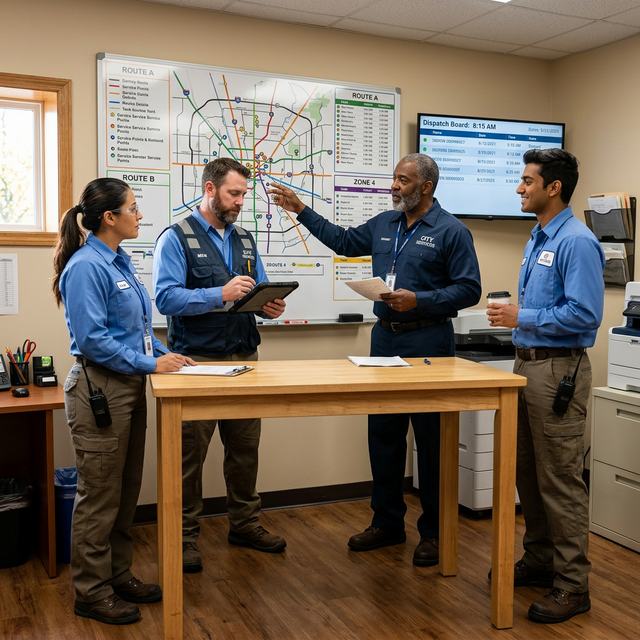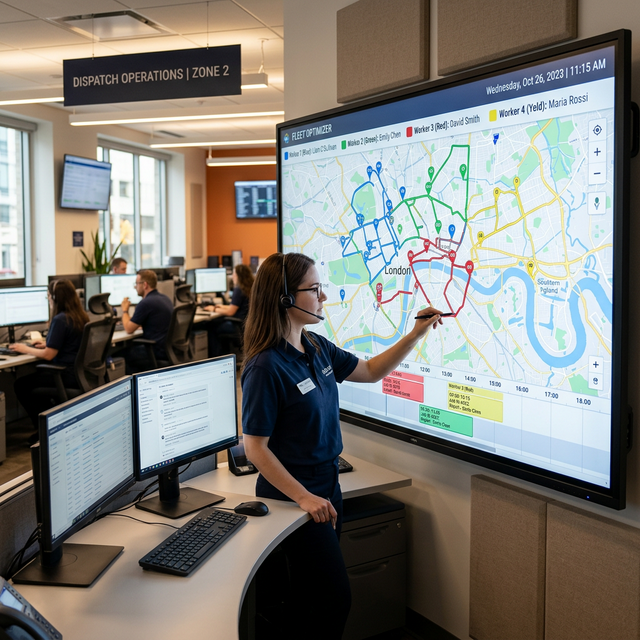
AI dispatch enables multi-location scaling by providing a single management dashboard across all locations, consistent customer experience through centralized AI call handling, and location-specific operational flexibility. Businesses that scale with an AI voice agent grow 3x faster than those using traditional human dispatch.
The Multi-Location Challenge
85% of service businesses that attempt multi-location expansion with manual dispatch systems experience severe service quality degradation within the first 6 months. The primary failure: inconsistent customer experience caused by different dispatchers, different processes, and different standards.
Scaling a service business from one location to two is the hardest growth step. You are replicating everything that made your first location successful: the customer experience, the response time, the worker quality, the operational standards. Do it wrong, and the second location damages the brand you built at the first.
Traditional multi-location expansion requires hiring a dispatcher at each location, training them to match your standards, and hoping they maintain consistency when you are not watching. AI dispatch eliminates this risk by centralizing call handling, scheduling, and dispatch under one autonomous system.
Centralized vs. Distributed Architecture
| Aspect | vs | Traditional (Distributed) | AI Dispatch (Centralized) |
|---|---|---|---|
| Call handling | vs | Separate staff per location | Single AI agent routes by location |
| Scheduling | vs | Independent calendars | Unified scheduling across all locations |
| Worker assignment | vs | Location-locked | Cross-location coverage enabled |
| Quality standards | vs | Varies by human dispatcher | Consistent (defined once, applied everywhere) |
The Single-Number Advantage: Customers do not need to know which franchise location serves their area. They call one central number, the AI instantly determines their location via API, and routes the call dynamically.
The Multi-Location Scaling Playbook
- Location 1: Establish your operations, refine the AI dispatch system, and achieve 80%+ fleet utilization.
- Location 2: Clone your dispatch configuration (AI persona, flat-rate pricing, scheduling rules) to the new market via API.
- Hire and onboard technicians in the new market using the centralized app.
- Launch with the same global phone number or local tracking numbers.
- Location 3+: Repeat the cloning process. Each new location scales with zero additional dispatch payroll.
The "cloning" process is what makes AI dispatch scaling highly profitable. Your AI voice persona, scheduling rules, and operational constraints are defined in code. Replicating them takes hours, not months.
"We used to dread opening a new city because hiring a reliable dispatcher was a nightmare. With DispatchNode, we just plug in the new service zone polygon, and the AI starts booking jobs in that city on day one."
Cross-Location Operations
AI dispatch natively enables operational flexibility that traditional siloed management cannot mathematically process:
- -Cross-location worker sharing during slow periods or emergencies.
- -Centralized demand-based staffing predictions via AI heatmaps.
- -Unified CRM history so a moving customer maintains their records.
- -Centralized Stripe billing and payment collection across all zones.
Multi-location service businesses face a unique dispatch challenge: centralized control versus local responsiveness. A centralized human call center ensures consistent experience but lacks local neighborhood knowledge. Local dispatchers know the territory but create massive staffing overhead. The AI dispatch model eliminates this tradeoff by ingesting local geography constraints while maintaining global brand consistency.
Operational Benchmarks for Multi-location scaling
| Metric | Before AI Dispatch | After AI Dispatch | Improvement |
|---|---|---|---|
| Lead Capture Rate | 55-65% | 95-100% | +40-45% |
| Booking Conversion | 35-45% | 70-82% | +35-37% |
| Response Time | 15-60 minutes | Under 30 seconds | 98% reduction |
| After-Hours Revenue | $0 | $3,000-$8,000/month | New revenue stream |
The SBA provides data showing that service businesses with automated lead capture systems grow 2.3x faster than those relying on manual phone answering alone.
Implementation Flow
sequenceDiagram
    participant Owner as Business Owner
    participant DN as DispatchNode
    participant AI as AI Voice Agent
    participant Customer as Customer

    Owner->>DN: Configures service catalog
    DN->>AI: Trains AI on business specifics
    Owner->>DN: Activates phone forwarding
    Customer->>AI: Calls business number
    AI->>AI: Handles full conversation
    AI->>DN: Books appointment automatically
    DN->>Owner: Sends notification
The entire setup process from account creation to live AI agent takes under 24 hours, with zero coding required.
Implementation Checklist
- Service Catalog Setup: Define every service offered, estimated duration, and pricing tier to populate the AI's knowledge base.
- Business Rules Configuration: Set service area boundaries, business hours, and appointment slot durations.
- AI Training: Provide industry-specific terminology, common customer questions, and preferred response patterns.
- Testing Phase: Run 15-20 test calls to validate AI accuracy before routing live customer traffic.
- Performance Monitoring: Track booking conversion rate, customer satisfaction, and revenue attribution weekly during the first month.
For a related analysis, read our guide on Service Area Expansion with AI Dispatch.
Multi-Location Scaling Architecture
Scaling a service business from one location to multiple locations introduces exponential complexity in dispatching, scheduling, and customer routing. The AI dispatch platform addresses this complexity by treating all locations as nodes in a unified logistics network. When a customer calls, the AI identifies their location and routes them to the nearest service area, checks technician availability across all locations, and books the optimal appointment regardless of which physical office manages the territory. This centralized intelligence prevents the common failure mode where one location is overbooked while another has idle capacity. The platform also enables cross-location technician sharing during high-demand periods, maximizing utilization across the entire business network. The financial impact is substantial: businesses using centralized AI dispatch across multiple locations report 18-25% higher revenue per location compared to businesses using independent scheduling systems at each site.
Centralized Data Sovereignty in Distributed Networks
The defining challenge of scaling a service business from a single successful location to a sprawling, multi-state regional empire is the terrifying loss of operational control. As the business owner opens new branches in different cities, they are forced to hire new regional managers, new dispatchers, and new field technicians. Without a rigid, technologically enforced unified architecture, these new branches rapidly devolve into independent fiefdoms.
Branch A in Texas might utilize a specific pricing matrix and a highly aggressive sales script, while Branch B in Oklahoma utilizes a completely different software tool and a passive, low-conversion intake process. This fragmentation destroys the brand's consistency, makes enterprise-wide financial reporting impossible, and creates massive, untrackable liabilities for the parent company.
DispatchNode provides the ultimate solution for multi-location scaling through absolute "Centralized Data Sovereignty." The platform allows the executive team to deploy a unified, omnipresent AI dispatch architecture across the entire geographic footprint from a single centralized command center.
When a customer calls the local number for the newly opened Oklahoma branch, they do not speak to a newly hired, poorly trained local dispatcher who might deviate from company policy. They interact with the exact same highly optimized, mathematically perfect AI agent that handles the highly profitable Texas headquarters. The AI enforces the parent company's exact pricing models, compliance scripts, and branding guidelines with zero deviation. This centralized architecture allows the business owner to aggressively acquire competitors or open new territories with absolute confidence, knowing that the operational integrity of the brand is protected by an impenetrable layer of software logic.
Algorithmic Load Balancing Across Regional Borders
Scaling a multi-location enterprise frequently introduces massive inefficiencies regarding resource allocation. A regional manager might realize that their Dallas branch is entirely overwhelmed with emergency HVAC calls during a heatwave, forcing them to turn away lucrative jobs. Simultaneously, their Fort Worth branch, only forty miles away, might be experiencing an abnormally slow day with three technicians sitting idle.
In a fragmented, human-managed system, the Dallas dispatcher lacks the visibility or the authority to commandeer the Fort Worth technicians, resulting in catastrophic revenue loss for the parent company despite having available resources within the broader network.
Advanced AI dispatch platforms resolve this through "Algorithmic Load Balancing." Because the platform possesses real-time, global visibility into the GPS locations, skill sets, and schedule availability of every single technician across the entire multi-state network, it treats geographic borders as fluid rather than absolute.
If the Dallas heatwave triggers an overwhelming surge in inbound requests, the AI algorithm instantly identifies the capacity crisis. It automatically scans the perimeter of the Dallas territory and identifies the idle Fort Worth technicians. The AI then seamlessly routes the overflow Dallas jobs directly to the mobile devices of the Fort Worth technicians, dynamically shifting resources across regional borders to ensure the enterprise captures every single dollar of available revenue. This algorithmic fluidity transforms a rigid collection of isolated branches into a single, massive, hyper-efficient logistical organism.
The financial reporting consolidation that centralized AI dispatch enables transforms multi-location management from a fragmented collection of independent P&L statements into a unified business intelligence platform.
The territory management capabilities of centralized AI dispatch prevent the common multi-location problem of adjacent territories competing for the same customers. When two office locations share a geographic boundary, the AI routes calls from the overlap zone to the location with the most available capacity rather than allowing both locations to compete for the same customer.
The brand consistency benefits of centralized AI dispatch are particularly valuable for franchise operations where maintaining uniform customer experience across independently owned locations is a constant challenge. The AI delivers the same professional greeting, follows the same qualification process, and provides the same booking experience regardless of which franchise location the customer calls.
The operational intelligence generated by centralized AI dispatch across multiple locations reveals optimization opportunities that distributed systems cannot identify. When the AI handles calls for all locations through a single platform, it can detect cross-location demand imbalances and recommend resource reallocation. If one location has excess technician capacity while another is fully booked, the AI can offer customers in the overbooked territory appointments with technicians from the under-utilized location, maximizing revenue across the entire business network.
The centralized AI dispatch model solves the staffing crisis that plagues multi-location service businesses during expansion. Each new office location traditionally requires hiring at least one full-time receptionist or office manager to handle phone inquiries and schedule appointments. At an average fully loaded cost of forty-five thousand to fifty-five thousand dollars per year per hire, a five-location expansion adds two hundred twenty-five thousand to two hundred seventy-five thousand dollars in annual administrative payroll before the first service call is completed. The AI dispatch platform eliminates this incremental hiring by providing a single, centralized booking and dispatch system that routes every call from every location through the same AI agent. The AI identifies the caller's location, routes them to the appropriate service territory, and books the appointment with a technician assigned to that territory. This centralized model means the marginal cost of adding a new location's phone system to the AI platform is effectively zero, transforming multi-location expansion from a staffing challenge into a pure revenue opportunity.
The most common failure mode in multi-location service business scaling is inconsistent customer experience across locations. When each office operates independently with its own phone system and scheduling process, customers calling different locations receive wildly different service quality.
The Micro-Economics of Wrench Time
The financial viability of a field service enterprise is entirely dependent on a single, brutally unforgiving metric: the ratio of "Windshield Time" to "Wrench Time." A business owner pays their technicians an hourly rate regardless of what the technician is doing. If a highly skilled commercial electrician earning $60 an hour spends four hours of their day stuck in gridlock traffic driving between poorly routed jobs, the enterprise is bleeding capital. That is "Windshield Time." It generates zero revenue and burns expensive diesel fuel, actively degrading the enterprise's net profit margin.
Conversely, "Wrench Time" is the hyper-valuable operational phase where the technician is physically on-site, executing the repair, and actively generating billable revenue. The entire objective of an operational software suite is to mathematically maximize the percentage of the day spent in Wrench Time.
Legacy dispatch software fails this objective because it relies on static routing. It assigns a morning manifest and hopes traffic patterns hold. Advanced AI dispatch architectures approach this problem as a continuous, dynamic algorithmic calculus. The platform ingests real-time API data from municipal traffic sensors, weather radar, and localized supply house inventory levels. If a major accident occurs on the interstate, the AI instantly detects the anomaly before the technician even turns the ignition. The algorithm autonomously recalculates the entire fleet's manifest, shuffling jobs between technicians to ensure that nobody is routed directly into the gridlock. By executing these micro-adjustments continuously throughout the day, the platform systematically converts wasted Windshield Time back into highly profitable Wrench Time, driving massive, compounded gains in overall fleet yield without requiring a single additional hour of labor.
Ultimately, the strategic deployment of advanced algorithmic routing and predictive intelligence completely shields the field service enterprise from volatile market conditions. By maintaining an unyielding focus on maximizing billable utilization rates, while simultaneously enforcing absolute mathematical precision across all dispatch operations, the organization fundamentally guarantees long-term operational resilience. This technological leverage secures compounding financial dominance within its specific geographic territory, permanently outpacing slower, manual competitors while insulating the enterprise from catastrophic macroeconomic shifts.
Keep reading:
 and Why Service Businesses Need It](/_next/image?url=%2Fassets%2Fblog%2Froute_optimization_costs.png&w=3840&q=75)