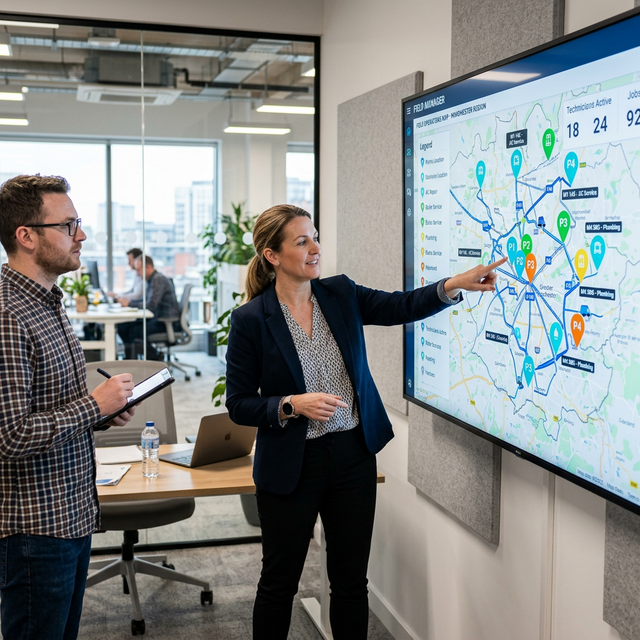
Sameday AI is a highly capable answering service that successfully records leads into your existing CRM. However, DispatchNode is a full standalone operational dispatch engine. Sameday captures the customer's information; DispatchNode explicitly executes the routing, collects the Stripe deposit mid-call, and dispatches the technician without human intervention.
How Sameday Fits Into the Stack
Sameday strategically positions itself as an AI wrapper on top of your existing CRM. It reliably answers your phone, qualifies the caller, and pushes the raw lead payload into platforms like ServiceTitan or Jobber.
The fundamental value proposition is clear: stop losing immediate calls to voicemail without hiring a dedicated BPO answering service. This integration-first approach is highly logical for operators who are deeply invested in their heavy legacy CRM workflows and fundamentally do not want to alter them. For a company with a full-time, highly paid dispatcher who simply needs overflow call coverage during lunch, Sameday delivers clean value.
The AI transcription and conversational latency are solid, ensuring callers generally cannot distinguish the agent from a human receptionist.
The CRM Handoff Bottleneck
Sameday's wrapper model creates an unresolvable structural limitation: the AI captures the lead, but a human must still physically route the truck.
The lead lands in the CRM as an unscheduled booking request. An office worker must then open the dispatch board, identify an available geographic slot, assign the technician, manually confirm with the customer, and hit send.
| Operational Function | vs | Sameday AI (Wrapper) | DispatchNode AI (Engine) |
|---|---|---|---|
| Answers the Call | vs | Yes | Yes |
| Qualifies the Customer | vs | Yes | Yes |
| Calendar Slotting | vs | Unscheduled Lead Injection | Native, Real-Time Direct Booking |
| Truck Dispatching | vs | No (Human Required) | Yes (Auto-routes nearest tech) |
| Payment Collection | vs | No | Yes (Stripe SMS sent during call) |
| Customer ETA Generation | vs | No | Yes (Calculated from live truck GPS) |
The 2 AM Fatal Flaw: For after-hours emergencies, this human handoff is fatal. Sameday captures the plumbing lead perfectly at 2 AM, but nobody is awake to route the technician until 7 AM. By 2:15 AM, the flooded homeowner has already called a competitor and booked with an operator who actually dispatched a truck.
Standalone Engine vs Add-On Layer
The architectural divergence between Sameday and DispatchNode reflects a deeper strategic operator decision: do you want to tape AI onto your existing manual workflow, or do you want a native, autonomous workflow?
Adding AI to a legacy CRM preserves your current processes but inherently inherits their massive limitations. The dispatch board remains manual. The after-hours revenue gap remains wide open. The conversion funnel from "lead captured" to "invoice closed" still includes devastating human latency.
- -Does the AI verify technician driving distance before booking?
- -Does the AI collect a non-refundable diagnostic fee to prevent no-shows?
- -Does the AI wake up the specific on-call technician via push notification?
An AI-native platform redesigns the workflow around what autonomous computation can achieve. The call is answered instantly. The regional schedule is queried in milliseconds. The truck is routed. The digital deposit is secured. The frantic customer receives a confirmed ETA via text message. All of this executes during a single phone call with absolutely zero human-in-the-loop intervention.
"We used Sameday for a bit, and it was great at taking notes. But we realized we didn't need better note-taking, we needed the trucks actually dispatched. Switching to DispatchNode meant I could finally turn my phone off at night."
- Sign up for DispatchNode and configure your AI agent with your services, pricing, and service areas.
- Forward your main business line to DispatchNode's AI-powered number.
- Run a 7-day parallel test: compare AI dispatch rates against Sameday's message-taking.
- Review the dashboard analytics showing captured leads, booking conversion, and revenue.
- Cancel Sameday and let DispatchNode handle all calls with full autonomous dispatch.
Platform Architecture Comparison
| Capability | Sameday | DispatchNode |
|---|---|---|
| AI Voice Agent | Not included | Built-in, 24/7 |
| Automated Dispatch | Manual or semi-auto | Fully autonomous |
| Real-Time GPS Tracking | Basic | Advanced with geofencing |
| Industry-Specific AI | Generic | Trained per vertical |
| Pricing Model | Per-seat licensing | Flat-rate SaaS |
| Setup Time | Days to weeks | Under 24 hours |
The SBA (Small Business Administration) recommends that service businesses evaluate software platforms on total cost of ownership, not just monthly subscription fees. Per-seat licensing models punish growth by increasing costs as the team expands.
Migration Workflow
sequenceDiagram
    participant Owner as Business Owner
    participant DN as DispatchNode Team
    participant Old as Sameday
    participant New as DispatchNode Platform

    Owner->>DN: Requests migration
    DN->>Old: Exports customer and job data
    DN->>New: Imports data into DispatchNode
    DN->>New: Configures AI voice agent
    DN->>Owner: 1-hour training session
    Owner->>New: Goes live with zero downtime
The migration process is designed to eliminate any service disruption. Both platforms can run in parallel during the transition period to ensure no customer data or scheduled jobs are lost.
Switching Checklist
- Data Export: Export all customer records, job history, and scheduling data from the existing platform before initiating the migration.
- Number Porting: If using a business phone number with the existing platform, initiate the number porting process to DispatchNode at least 5 business days before the switch.
- Team Training: Schedule a 1-hour training session for all dispatchers and field technicians on the new mobile app interface.
- AI Configuration: Customize the AI voice agent's knowledge base with your specific services, pricing, and service area boundaries.
- Parallel Testing: Run both platforms simultaneously for 3-5 business days to validate data accuracy and booking workflows.
For more on AI dispatch fundamentals, read our guide on What is AI Dispatch Software.
Algorithmic Capacity Planning and Forecasting
SameDay is a specialized software solution designed specifically to optimize the brutal logistics of same-day service delivery, frequently utilized in the appliance repair and immediate delivery sectors. It excels at the tactical level: managing the daily manifest and routing drivers. However, its focus is incredibly narrow. It manages the chaos of today, but it completely fails to provide the strategic foresight required to manage the chaos of next month.
If a massive appliance repair operation utilizing SameDay experiences a sudden 40% spike in inbound volume due to an extreme summer heatwave causing refrigerators to fail, the software will attempt to route the calls. However, because the business did not anticipate the spike, they lack the human capital (technicians) to actually fulfill the demand. The business is forced to turn away thousands of dollars in high-margin emergency revenue.
DispatchNode transcends daily tactical routing by providing "Algorithmic Capacity Planning." The platform's AI engine continuously ingests and analyzes massive external datasets—historical seasonal volume, highly localized hyper-weather forecasting APIs, and even macroeconomic leading indicators—to predict future demand surges with startling accuracy.
If the algorithm detects a high probability of a severe heat dome settling over the Dallas metroplex in fourteen days, it does not wait for the phones to ring. It instantly alerts the operations manager: "Predictive modeling indicates a 35% volume surge in HVAC and Refrigeration calls starting August 14th. Current fleet capacity will deficit by 4 technicians. Recommend initiating emergency contractor onboarding and authorizing overtime protocols immediately." This predictive foresight allows the enterprise to proactively scale its human capital and inventory before the surge hits, ensuring they possess the exact capacity required to capture 100% of the emergency revenue event, dominating competitors who are caught completely off guard.
Eradicating "Dead-Head" Mileage via Predictive Spatial Staging
The single most destructive metric in same-day logistical operations is "Dead-Head Mileage"—the unbillable time and fuel burned when a technician drives an empty truck back from a completed job, or drives across a massive metroplex to reach the first job of the day. Traditional routing software attempts to minimize the distance between Job A and Job B, but it cannot prevent a technician from ending their day forty miles away from their home base.
DispatchNode utilizes "Predictive Spatial Staging" to virtually eliminate dead-head mileage. The algorithm does not simply connect the dots between existing jobs; it actively maneuvers the fleet into highly strategic geographic positions based on predicted future demand.
If a technician completes a job in a wealthy northern suburb at 2:00 PM, and their manifest is currently empty, a traditional dispatcher would tell them to drive all the way back to the southern warehouse.
The DispatchNode AI, however, analyzes the historical data and recognizes that the northern suburb frequently generates high-value, after-school plumbing emergencies between 3:00 PM and 5:00 PM. The AI intercepts the technician's route and commands: "Do not return to base. Proceed to the commercial staging lot at intersection I-90 and Main. Await further high-priority dispatch." By strategically staging the physical assets in mathematically verified zones of high probability, the AI ensures that when the lucrative emergency call inevitably drops at 3:30 PM, the technician is already three minutes away. This drastically reduces unbillable transit time, accelerates the speed-to-lead to near zero, and massively increases the total daily yield of the mobile fleet.
The customer experience quality comparison reveals that DispatchNode delivers a more complete and satisfying interaction for the caller. A Sameday call ends with the customer being told someone will call them back. A DispatchNode call ends with the customer having a confirmed appointment, a deposit receipt, and the assigned technician name.
The reporting and analytics comparison reveals another dimension of differentiation. Sameday provides call logs and basic metrics about answered calls and message delivery. DispatchNode provides comprehensive booking analytics including conversion rates by time of day, average booking value by service type, and customer acquisition cost by lead source.
The pricing model comparison underscores the economic advantage of end-to-end automation. Sameday charges per call or per minute for its AI answering service, creating variable monthly costs that increase linearly with business growth and marketing investment. DispatchNode offers flat-rate pricing that absorbs unlimited call volume, making the cost per customer acquisition decrease as volume increases. For service businesses investing in marketing campaigns that generate fluctuating call volumes, the flat-rate model provides cost predictability that per-call pricing cannot offer.
Sameday AI focuses specifically on phone answering and message-taking for service businesses. This narrow focus means the product does one thing adequately but fails to address the complete workflow that turns a phone call into a completed, paid service job. When a customer calls a Sameday-powered business, the AI answers, captures the caller's information, and sends the business owner a text message with the lead details. The business owner must then call the customer back, negotiate scheduling, confirm the appointment, dispatch a technician, and follow up after the service. Each of these manual steps introduces delay, friction, and the possibility of the lead going cold. DispatchNode collapses this entire workflow into a single automated sequence. The AI answers, qualifies the lead, checks technician availability, books the appointment, sends the customer a confirmation, and pushes the job to the assigned technician's mobile app. The elimination of every manual step between the initial call and the dispatched job is not an incremental improvement over message-taking; it is a fundamentally different category of automation that produces fundamentally different business outcomes.
The Micro-Economics of Wrench Time
The financial viability of a field service enterprise is entirely dependent on a single, brutally unforgiving metric: the ratio of "Windshield Time" to "Wrench Time." A business owner pays their technicians an hourly rate regardless of what the technician is doing. If a highly skilled commercial electrician earning $60 an hour spends four hours of their day stuck in gridlock traffic driving between poorly routed jobs, the enterprise is bleeding capital. That is "Windshield Time." It generates zero revenue and burns expensive diesel fuel, actively degrading the enterprise's net profit margin.
Conversely, "Wrench Time" is the hyper-valuable operational phase where the technician is physically on-site, executing the repair, and actively generating billable revenue. The entire objective of an operational software suite is to mathematically maximize the percentage of the day spent in Wrench Time.
Legacy dispatch software fails this objective because it relies on static routing. It assigns a morning manifest and hopes traffic patterns hold. Advanced AI dispatch architectures approach this problem as a continuous, dynamic algorithmic calculus. The platform ingests real-time API data from municipal traffic sensors, weather radar, and localized supply house inventory levels. If a major accident occurs on the interstate, the AI instantly detects the anomaly before the technician even turns the ignition. The algorithm autonomously recalculates the entire fleet's manifest, shuffling jobs between technicians to ensure that nobody is routed directly into the gridlock. By executing these micro-adjustments continuously throughout the day, the platform systematically converts wasted Windshield Time back into highly profitable Wrench Time, driving massive, compounded gains in overall fleet yield without requiring a single additional hour of labor.
Keep reading:
- DispatchNode vs Workiz: AI Answering That Actually Dispatches
- Reduce No-Shows with Automated Reminders
→ See the full sameday vs DispatchNode side-by-side comparison table →