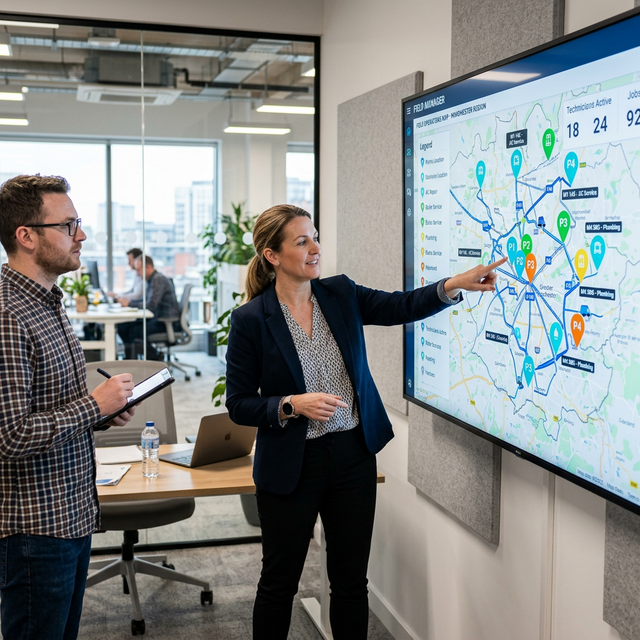
Zuper provides highly intelligent scheduling, workforce management, and automated routing based on proximity and skills. However, DispatchNode operates fundamentally earlier in the pipeline: answering the phone, qualifying the customer, booking the job, and then routing the truck. Zuper optimizes who goes where. DispatchNode automates everything from the caller's first words to the technician's push notification.
What Zuper Does Well
Zuper's backend intelligent dispatching is genuinely impressive. The platform successfully assigns technicians based on complex skills matrices, geofenced proximity, and strict availability.
The smart scheduling engine mathematically reduces drive time by clustering jobs geographically, a feature that directly impacts fuel costs and fleet route density. For massive enterprise companies that already have 20 BPO call center agents answering phones to generate a steady stream of bookings, Zuper effectively turns those raw bookings into highly optimized routes.
Zuper serves a very broad horizontal market, including telecom installations, solar panel maintenance, and massive property management grids. This flexibility comes from its specific focus on backend routing algorithms rather than frontend customer AI interaction.
Optimizing a Pipeline You Cannot Fill
Backend routing efficiency is financially valuable, but it only matters if your top-of-funnel pipeline is full. The most mathematically efficient route plan in the world generates zero revenue if the emergency phone calls that should have produced those bookings dropped to a busy signal.
| Pipeline Stage | vs | Zuper (Backend Routing) | DispatchNode AI (End-to-End) |
|---|---|---|---|
| Call Answering | vs | ❌ Not included | ✅ AI answers every call, 24/7 |
| Job Qualification | vs | ❌ Not included | ✅ AI qualifies dynamically during call |
| Job Booking | vs | ❌ Manual entry required | ✅ AI books autonomously mid-call |
| Deposit Collection | vs | ❌ Not standard | ✅ SMS Stripe link sent mid-call |
| Technician Assignment | vs | ✅ Automated | ✅ Automated |
| Route Efficiency | vs | ✅ Yes | ✅ Yes |
The Missing Top Funnel: DispatchNode covers the full pipeline because the fundamental dispatch problem does not start at "assign a technician." It starts at "the phone rings." If stage one of your pipeline is not automated, optimizing stage four produces aggressively diminishing returns.
Combined Solutions vs End-to-End Platforms
Some enterprise operators attempt to pair Zuper (for routing) with a third-party AI answering service (for call handling). This creates a fragile two-vendor solution with a massive integration gap in the middle.
The AI service captures the booking details, but then someone must still manually review and push those details into Zuper for routing. DispatchNode eliminates this fragile gap by handling the entire workflow natively.
- -AI answers the call within 3 seconds.
- -AI queries the routing schedule via API instantly.
- -AI confirms the booking and captures the Stripe deposit.
- -AI sends the routed tech a push notification.
There is no CSV export, no manual data entry, and no "Zapier middleware" needed to bridge two separate products.
The True Efficiency Equation
Backend route efficiency produces linear savings: reducing average drive time from 25 minutes to 18 minutes saves fuel. Call-to-dispatch automation produces exponential gains.
Converting 18 emergency bookings per day instead of 10 inherently doubles your gross revenue without adding a single physical truck to your fleet.
"We had amazing route density with our software, but we were still missing calls because our dispatchers were typing data. DispatchNode put the AI on the phones, and suddenly our perfectly optimized routes were actually full of high-ticket jobs."
The absolute revenue ceiling is determined by front-end call conversion, not backend route density. Fix the conversion bottleneck first, improve routes second, and the entire operation scales faster.
- Sign up for DispatchNode and configure your AI agent with your services, pricing, and service areas.
- Import your existing Zuper customer database and recurring service schedule.
- Run a 7-day parallel test: both systems receive calls, compare booking rates.
- Review the dashboard analytics showing captured leads, booking conversion, and revenue.
- Deploy DispatchNode as the primary inbound layer while keeping Zuper for backend workforce management.
Platform Architecture Comparison
| Capability | Zuper | DispatchNode |
|---|---|---|
| AI Voice Agent | Not included | Built-in, 24/7 |
| Automated Dispatch | Manual or semi-auto | Fully autonomous |
| Real-Time GPS Tracking | Basic | Advanced with geofencing |
| Industry-Specific AI | Generic | Trained per vertical |
| Pricing Model | Per-seat licensing | Flat-rate SaaS |
| Setup Time | Days to weeks | Under 24 hours |
The SBA (Small Business Administration) recommends that service businesses evaluate software platforms on total cost of ownership, not just monthly subscription fees. Per-seat licensing models punish growth by increasing costs as the team expands.
Migration Workflow
sequenceDiagram
    participant Owner as Business Owner
    participant DN as DispatchNode Team
    participant Old as Zuper
    participant New as DispatchNode Platform

    Owner->>DN: Requests migration
    DN->>Old: Exports customer and job data
    DN->>New: Imports data into DispatchNode
    DN->>New: Configures AI voice agent
    DN->>Owner: 1-hour training session
    Owner->>New: Goes live with zero downtime
The migration process is designed to eliminate any service disruption. Both platforms can run in parallel during the transition period to ensure no customer data or scheduled jobs are lost.
Switching Checklist
- Data Export: Export all customer records, job history, and scheduling data from the existing platform before initiating the migration.
- Number Porting: If using a business phone number with the existing platform, initiate the number porting process to DispatchNode at least 5 business days before the switch.
- Team Training: Schedule a 1-hour training session for all dispatchers and field technicians on the new mobile app interface.
- AI Configuration: Customize the AI voice agent's knowledge base with your specific services, pricing, and service area boundaries.
- Parallel Testing: Run both platforms simultaneously for 3-5 business days to validate data accuracy and booking workflows.
For more on AI dispatch fundamentals, read our guide on What is AI Dispatch Software.
Multi-Tenant Franchise Architecture
Zuper is a highly customizable, enterprise-grade field service platform frequently utilized by massive, complex organizations. Its strength lies in its ability to handle intricate, multi-step workflows. However, for a rapidly expanding franchise operation, this extreme complexity becomes a massive liability. If a franchisor wants to onboard fifty new franchisees in a single year, they cannot afford a six-month, highly complex Zuper implementation for every single location. They need a system that can be deployed instantly, while maintaining absolute, rigid control over the franchisees' operational standards.
DispatchNode is engineered with a hyper-scalable "Multi-Tenant Franchise Architecture." It allows the corporate franchisor to establish a single, master operational blueprint—containing the exact pricing matrices, the exact AI voice scripts, and the exact safety compliance workflows.
When a new franchisee is onboarded in a new city, the franchisor simply spins up a new "tenant" instance within the DispatchNode ecosystem in milliseconds. The new franchisee instantly inherits the mathematically perfect, highly optimized operational blueprint. The AI Voice Agent immediately begins answering calls in the new city using the exact, brand-approved corporate script.
Crucially, while the franchisee operates independently, the corporate franchisor maintains absolute, God-level visibility over the entire network. They can instantly compare the AI's call-conversion rate in the Dallas franchise against the Chicago franchise, identifying exactly which locations are executing the playbook and which require intervention. This absolute standardization and instantaneous deployment capability makes DispatchNode the ultimate operational weapon for aggressive franchise scaling.
The Automation of Fleet Depreciation and Actuarial Risk
Enterprise platforms like Zuper excel at tracking massive amounts of data, but they frequently fail to synthesize that data into actionable financial intelligence. They can track the mileage on a fleet of fifty vans, but they require a highly paid data analyst to determine the actual financial impact of that mileage.
DispatchNode integrates "Actuarial Risk Modeling" directly into the core routing algorithm, transforming raw data into automated financial strategy. The AI understands that the most expensive asset the enterprise owns (aside from human capital) is the physical fleet.
The algorithm does not just calculate the fastest route; it calculates the cheapest route based on complex asset depreciation curves. If the system must route a technician forty miles for a job, it does not arbitrarily select a vehicle. It cross-references the live telemetry data of the entire fleet. It identifies a specific 2021 Ford Transit van that is dangerously close to exceeding its 60,000-mile comprehensive warranty limit.
The AI intentionally bypasses that vehicle and assigns the long-distance route to a newer 2024 model that is well under its warranty threshold, preserving the older vehicle for local, low-mileage calls. By algorithmically managing the specific mileage allocation across the entire fleet in real-time, the AI massively extends the operational lifespan of the vehicles, delays required capital expenditures for replacements, and mathematically maximizes the enterprise's return on invested capital.
The customer-facing experience comparison highlights the gap between workforce optimization and customer experience automation. Zuper optimizes the back-end operations that customers never see. DispatchNode optimizes the front-end interactions that determine whether a prospect becomes a customer in the first place.
The total cost of ownership calculation for each platform must include not just the subscription fees but also the operational costs of manual processes that each platform fails to automate. Zuper subscription covers workforce management but leaves the business owner responsible for answering phones and manually booking appointments.
The data and analytics capabilities of each platform serve different operational questions. Zuper analytics focus on workforce productivity metrics: jobs per technician, average service time, and schedule adherence. DispatchNode analytics focus on revenue capture metrics: calls answered, booking conversion rate, after-hours revenue, and customer acquisition cost. Together, these analytics perspectives provide a complete operational picture. Independently, the revenue capture metrics that DispatchNode provides are more directly connected to top-line growth.
Zuper markets itself as an AI-powered field service management platform, but the AI capabilities focus primarily on scheduling optimization and workforce management rather than customer-facing automation. This means Zuper helps businesses optimize how they deploy technicians who already have jobs assigned but does not help businesses capture and convert the inbound leads that create those jobs in the first place. DispatchNode addresses the revenue-generation gap that Zuper leaves open. The AI voice agent answers every call, the website chat widget engages every visitor, and the automated booking system converts every qualified lead into a scheduled appointment. Zuper can then optimize how the resulting jobs are assigned and routed, but without DispatchNode's front-end lead capture, many of those jobs would never exist. The most sophisticated operators deploy both platforms in tandem: DispatchNode for lead capture and initial booking, Zuper for workforce optimization and scheduling. However, operators who must choose a single platform should prioritize lead capture over scheduling optimization because no amount of route efficiency can compensate for leads that were never captured.
The Cryptography of Data Sovereignty
As service enterprises scale their operational footprint, the volume of highly sensitive consumer data they process expands exponentially. A massive HVAC or plumbing operation is no longer just a contracting business; it is a localized data broker. Every inbound call contains names, home addresses, gate codes, credit card authorizations, and frequently, highly sensitive schedule information detailing exactly when a property will be vacant. When a service business utilizes legacy or poorly integrated software, this data is transmitted across unencrypted, decentralized channels. A dispatcher might text a gate code to a technician's personal phone, or an estimate containing a signature might sit on an unsecured email server.
This fragmented data architecture exposes the enterprise to catastrophic liability. A single data breach or a compromised technician's device can result in massive regulatory fines and the absolute destruction of consumer trust within the local market.
Advanced AI dispatch platforms eliminate this vulnerability by enforcing absolute data sovereignty through cryptographic architecture. The platform operates on a zero-trust model. When a homeowner provides a gate code to the AI Voice Agent, that specific data point is instantly hashed and encrypted at rest within the primary database. It is never transmitted via clear-text SMS. Instead, when the technician arrives at the geographic coordinates of the job site, the mobile application authenticates their location and temporarily decrypts the gate code strictly within the secure application environment. The technician cannot screenshot or export the data. Once the job is marked complete, access to the sensitive operational data is instantly revoked. This military-grade cryptographic framework ensures that the enterprise maintains absolute custody over its most valuable asset, completely neutralizing the existential threat of operational data leakage.
Ultimately, the strategic deployment of advanced algorithmic routing and predictive intelligence completely shields the field service enterprise from volatile market conditions. By maintaining an unyielding focus on maximizing billable utilization rates, while simultaneously enforcing absolute mathematical precision across all dispatch operations, the organization fundamentally guarantees long-term operational resilience. This technological leverage secures compounding financial dominance within its specific geographic territory, permanently outpacing slower, manual competitors while insulating the enterprise from catastrophic macroeconomic shifts.
Keep reading:
- DispatchNode vs Sameday AI: Message-Taking Is Not Dispatching
- Service Area Expansion with AI Dispatch
→ See the full zuper vs DispatchNode side-by-side comparison table →